

Thirty-eight degrees, and the TDI cranks four full seconds before it catches. All summer it fired the moment you turned the key. Nothing on the car changed except the air temperature, which is exactly the tell.
Glow plugs are the first thing to check on a German diesel that starts hard in the cold, and around Farmington the calls start in October. A marginal circuit will still get you to work in 50-degree weather. Give it a 20-degree morning in December and it becomes a tow off Farmington Road.
Quick Summary: Key Takeaways
- Cold-only hard starting: Fires fine warm, cranks long cold. That is the glow plug circuit, not the battery.
- Plugs quit one at a time: Lose one and the first minute is rough and smoky. Lose two and it may not catch.
- The control module fails too: A dead output driver inside the module mimics a dead plug perfectly.
- Seized plugs drive the bill: Carbon welds plugs into the head, so extraction labor decides the price.
- October is the real deadline: The first hard freeze is when a weak circuit stops pretending.
A Long Crank in the Cold Points at Glow Plugs, Not the Battery
If the starter spins the engine over fast and it still won’t light, the battery is doing its job. Cranking speed is the battery’s report card. Slow, labored, dying cranking is electrical supply; fast cranking with no combustion is a heat problem inside the cylinder.
Diesels have no spark. They live on compression heat alone, and on a cold soak the aluminum head pulls that heat straight out of the air charge — which is exactly why the factory fitted an electric heater in each cylinder.
So a healthy battery and a hard cold start are not a contradiction. They’re a clue. Owners replace two batteries before anyone tests a glow plug, and we see the receipts every autumn.
What the Glow Plug System Actually Does on a Modern German Diesel
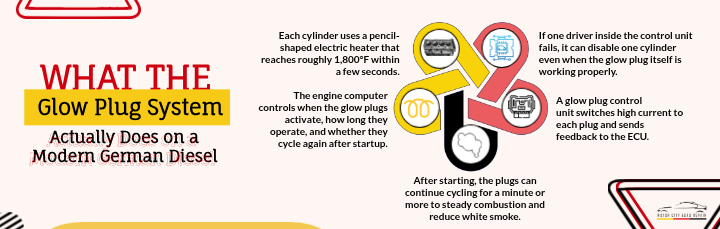
Each cylinder gets a pencil-shaped electric heater that runs to roughly 1,800 degrees Fahrenheit in a couple of seconds. The engine computer decides when they come on, how long they stay on, and whether they fire again after the engine starts.
The post-heat cycle is the part people forget. On a Mercedes or Volkswagen diesel the plugs keep cycling for a minute or more after startup to steady combustion and cut the white smoke.
None of it happens without the module. A separate glow plug control unit switches high current to each plug and reports back to the ECU, so one failed driver inside that box takes out one cylinder even when the plug itself is perfect.
The Symptoms Show Up Weeks Before the No-Start
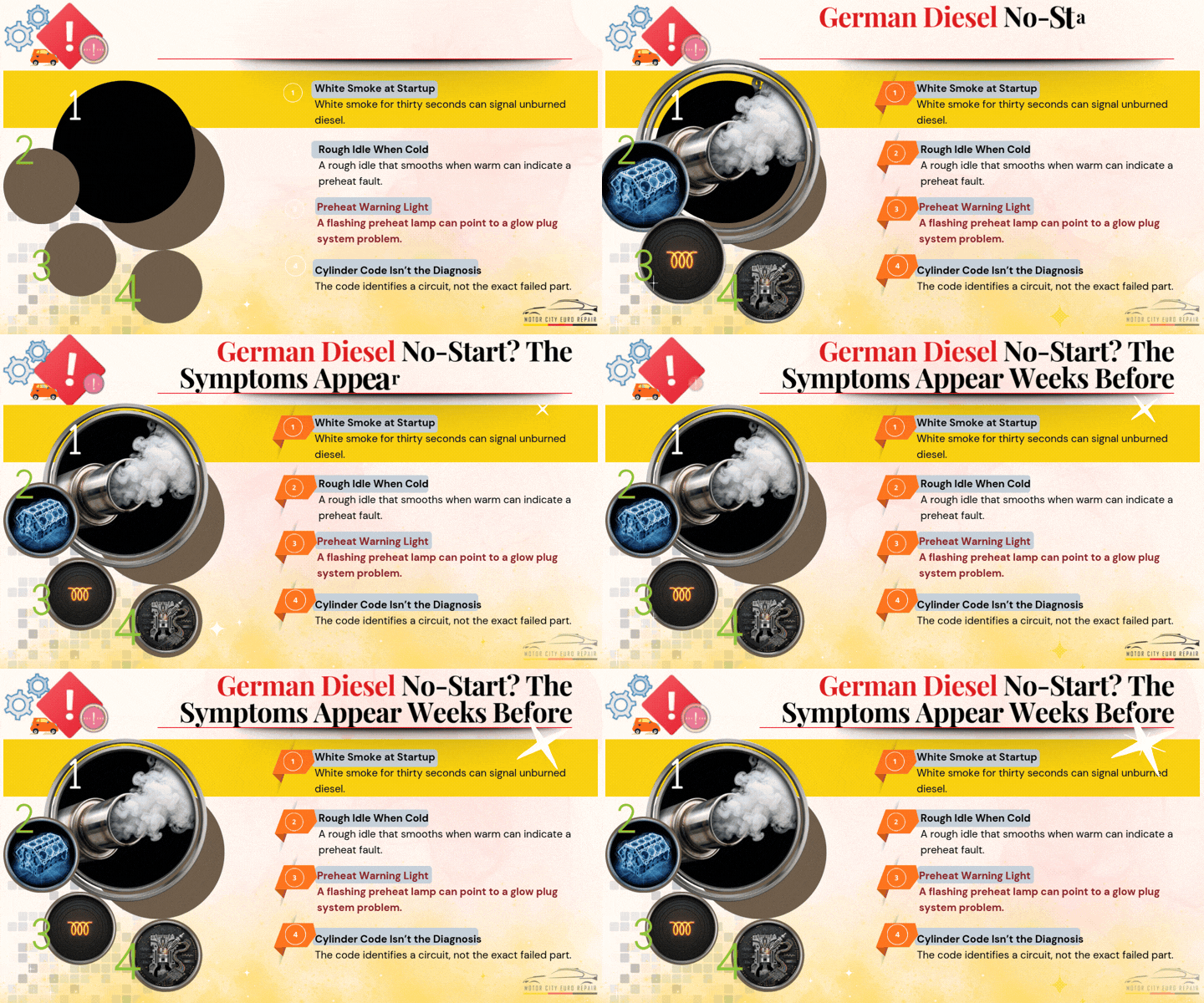
White smoke at idle for the first thirty seconds is the classic early warning. Unburned diesel is going out the tailpipe because one cylinder isn’t contributing yet, and the smell in the driveway is unmistakable.
Watch for the shudder. A rough idle that smooths as the engine warms, a stored P0670-range code, and a preheat lamp that flashes instead of going out are the same story told three ways.
A stored code that says cylinder three is not a diagnosis — it’s a starting point. Plug, wiring, connector, module: any of the four produces the same code.
Measuring the Circuit Beats Guessing at Four Plugs
Testing takes about half an hour and it settles the argument. We command the glow plugs on with a scan tool, then watch current draw on each circuit with a clamp, because a good plug pulls a healthy inrush and then tapers as it heats.
An open plug draws nothing. A shorted one pulls hard and never tapers. A module with a failed driver leaves a perfectly good plug sitting at zero amps no matter what the computer asks.
Then the boring stuff. Battery voltage under load, the glow relay feed, the ground at the head, and the connector on top of each plug — which cooks year after year and crumbles when you touch it.
Seized Plugs Are Why the Labor Costs More Than the Parts
A glow plug is a cheap part. Getting an eight-year-old one out of an aluminum head after 90,000 miles of soot is the expensive half, and any shop quoting a flat 45 minutes has not done many.
Carbon builds up on the shank and effectively welds the plug in place. Done right, the job means soaking penetrant, heat-cycling the engine, and backing the plug out in small increments with a torque wrench rather than snapping it off in the head.
Snap one and the day changes. Extraction on a broken plug can mean specialty reamers and taps working through the plug hole, so we always recommend replacing all of them as a set once one has failed — you are already paying for the access.
Farmington Diesel Owners Have a Shorter Runway Than They Think
The window closes fast here. The National Weather Service office in White Lake notes that October is when the growing season ends across Southeast Michigan, with the average first 32-degree freeze landing inside that month, so the mornings that expose a weak glow plug circuit are already on the calendar.
Short trips make it worse. A five-mile run down Grand River to Farmington Hills never gets the engine fully warm, so an errand-duty diesel lives in the exact condition glow plugs exist to cover.
Our shop sits at 22455 Farmington Road, and we work on Audi, Bentley, BMW, Maybach, Mercedes, MINI, Porsche and Volkswagen — diesels included. Bring it in while it still starts.
Frequently Asked Questions
Q: How long should a diesel crank before it starts in cold weather?
A: Two seconds or less. A healthy German diesel should catch almost immediately at 30 or 40 degrees. Past three or four seconds of cold cranking, especially with white smoke, the preheat circuit needs testing.
Q: Can you drive with a bad glow plug?
A: You can. It gets worse. One dead plug means rough running and unburned fuel on every cold start, which loads the particulate filter and can foul that cylinder’s injector — and it is rarely the last plug to go.
Q: Do all the glow plugs have to be replaced at once?
A: Not technically, but it is the sensible call. The plugs age together and the access labor is the same either way, so returning in four months for a second seized plug costs more than doing the set today.
Q: Why does my glow plug light flash on the dash?
A: It is a fault report, not a wait signal. A flashing lamp usually pairs with a stored code for a specific cylinder or for the control module, and separating those two takes a scan tool.
Get the Preheat Circuit Tested Before the First Hard Freeze
October starts are forgiving. January starts are not. Book a diesel diagnostic and we will measure current on every glow plug circuit and tell you which parts are done.
Hours: Mon-Fri 8:00 AM-5:00 PM; Sat-Sun closed
Website: motorcityeuro.com
