

Audi’s Quattro all-wheel drive system is renowned for its traction, stability, and confident performance in all weather conditions — but it adds mechanical complexity that requires specialized knowledge when components wear out. One of the most common wear items in the Quattro drivetrain is the CV (constant velocity) joint on the drive shaft. When CV joints begin to fail, drivers notice distinctive symptoms that can quickly progress from annoying to dangerous if left unaddressed. At Motor City Euro Repair in Farmington, Michigan, our Audi specialists diagnose and repair Quattro drivetrain failures with precision.
What Are CV Joints and Why Do They Fail?
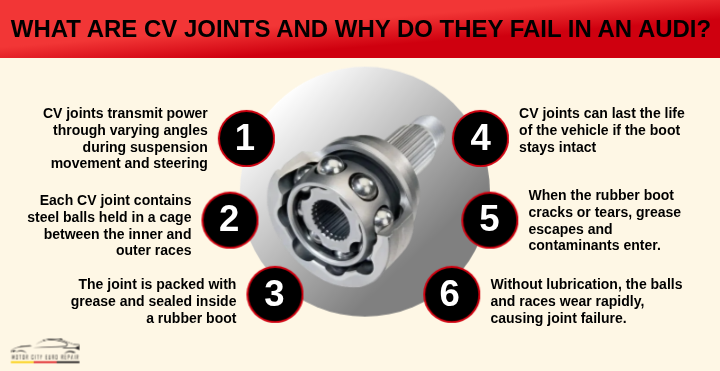
CV joints allow the drive shaft to transmit power through varying angles as the wheel moves up and down with the suspension and turns during steering. Inside each CV joint is a set of steel balls seated in a cage between inner and outer races, all packed with grease and sealed inside a rubber boot. As long as the boot remains intact and the grease stays clean, CV joints can last the life of the vehicle. However, when the rubber boot cracks or tears — whether from age, road debris, or excessive salt exposure in winter climates — grease escapes and contaminants enter. Without proper lubrication, the steel balls and races wear rapidly, leading to joint failure.
Symptoms of a Failing CV Joint on Your Audi
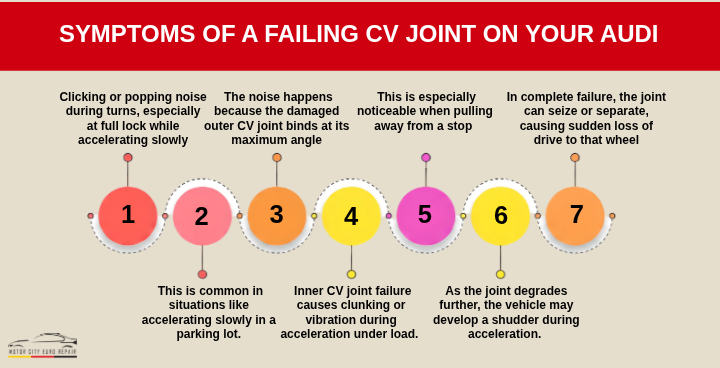
The classic symptom of a failing outer CV joint is a clicking or popping noise during turns, particularly when the steering is turned to full lock while accelerating slowly — such as in a parking lot. This noise occurs because the damaged joint binds when operating at its maximum angle. Inner CV joint failure tends to produce more of a clunking or vibration during acceleration under load, particularly noticeable when pulling away from a stop.
As the joint degrades further, the vehicle may develop a shudder during acceleration, and in a complete failure scenario, the joint can seize or separate — causing sudden loss of drive to that wheel.
Motor City Euro Repair’s Quattro Drivetrain Expertise
Our Audi technicians inspect each CV joint boot and joint condition during routine services and flag any early signs of boot cracking or grease leakage. When a CV joint has failed, we can replace just the joint and boot in many cases, or replace the complete half-shaft assembly when the shaft itself shows wear or damage. All replacement components meet or exceed Audi’s OEM specifications, and we verify proper shaft installation and torque to factory values before road testing. Schedule your appointment today!
Address: 22455 Farmington Rd, Farmington, MI 48336
Phone: (248) 471-2886
Website: motorcityeuro.com
Frequently Asked Questions
Q: Can I drive my Audi with a clicking CV joint?
A: A clicking CV joint that is still contained within an intact joint can usually be driven on for a limited time, but we strongly recommend scheduling a repair promptly. A joint that is failing will not improve on its own and can separate without warning.
Q: How do I know if it’s the inner or outer CV joint making noise on my Audi?
A: Outer joint failures typically produce clicking during turns. Inner joint failures tend to produce clunking or vibration during acceleration, particularly under load. Our technicians perform a specific test drive evaluation to distinguish between the two.
Q: Does Audi Quattro use CV joints on all four wheels?
A: Yes. All four wheels on a Quattro-equipped Audi have half-shafts with CV joints. The rear half-shafts are often overlooked during inspections, so our technicians check all four corners during any drivetrain evaluation.
Q: How long does a CV joint replacement take?
A: A single outer CV joint boot or joint replacement typically takes one to two hours. Full half-shaft replacement takes slightly longer. We can usually complete this repair the same day.
