

You start the 911 after it idled a few minutes in the driveway. Blip the throttle and a white cloud rolls out of the exhaust. Then it clears. That is the Porsche smoke screen, and the cause is almost always a torn air-oil separator diaphragm.
Oil spec matters here, and the U.S. Department of Energy points out that the wrong grade of motor oil lowers gas mileage by 1% to 2% while it also aerates differently under load.
Quick Summary: Key Takeaways
- White smoke after idling is the signature: A torn diaphragm feeds crankcase oil into the intake.
- The oil filler cap tells you a lot: Hard to remove means crankcase vacuum is too high.
- M96 and M97 engines are the usual patients: 996, 997.1, Boxster 986 and Cayman 987.
- Expect it near 60,000 to 90,000 miles: Many owners replace it during other work.
- Ignoring it risks the engine: Enough oil in a cylinder means hydro-lock. Or a runaway.
The AOS separates oil from crankcase vapor and controls engine vacuum
Your Porsche’s crankcase runs under slight vacuum by design, because blow-by gases build pressure below the crank as the engine works. The separator vents them.
It catches suspended oil mist and drains it back to the sump, while a rubber diaphragm with a calibrated spring limits how much manifold vacuum reaches the crankcase. Tear that diaphragm and the regulation disappears entirely. That is the failure.
Manifold vacuum then reaches straight into the engine, hauling liquid oil up the vent hose and into the intake tract, where none of it belongs. Simple part, serious consequences.
Seven symptoms give away a failing air-oil separator
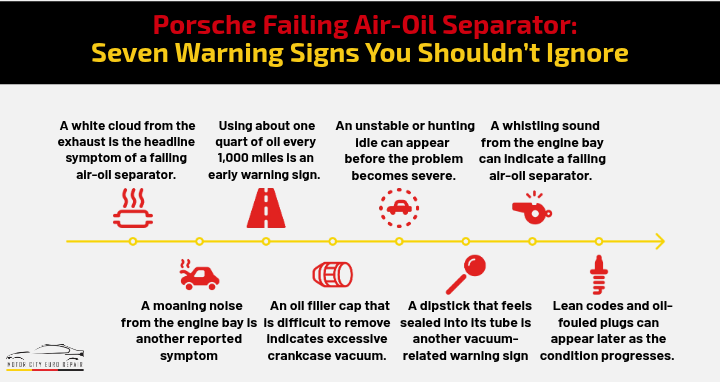
The white cloud after idling is the headline, but smaller signs arrive first, so watch for oil consumption of a quart every thousand miles. Add a hunting idle.
A whistling or moaning noise from the engine bay usually joins in, and then the vacuum clues start showing up on the parts you touch every week. An oil filler cap that fights you is one.
A dipstick sealed into its tube is another. Both mean crankcase vacuum has climbed well past the two to five inches of water column these engines should show. Watch the cap. Lean codes and oil-fouled plugs come later.
Short winter trips and stretched oil intervals accelerate AOS failure
Michigan driving is hard on this part, and short trips are the reason, because runs around Farmington and Grand River Avenue never bring the oil fully up to temperature. Water and fuel condense instead.
That acidic mist passes through the separator every day and attacks the rubber diaphragm, while heat cycling from cold soak to full operating temperature does the rest of the damage. After ten winters the diaphragm loses its elasticity.
A hairline split forms at the fold. Oil quality plays in too, since sludge blocks the drain-back passage that returns caught oil to the sump. Correct spec, changed on time.
Driving on a failed AOS puts the whole engine at risk
This is not a wait-and-see repair. Once the diaphragm tears, the intake is drinking engine oil, and throttle position plus idle time decide how much of it disappears.
Enough liquid oil in a cylinder will hydro-lock the engine or feed a diesel-style runaway that ignores the key, and either one turns a manageable job into a teardown. Rebuild costs on a flat-six surprise most owners.
Everyday damage is quieter. Oil coats the mass airflow sensor, saturates the catalytic converters, fouls the plugs and skews the fuel trims. You end up paying for parts the separator ruined.
Our Farmington techs measure crankcase pressure before replacing anything
We test rather than guess, starting with a manometer on the oil filler neck, which gives an actual crankcase vacuum reading at idle. Porsche specifies a narrow range.
If the reading is high, we inspect the vent hose for pooled oil, look inside the throttle body for wet residue and pull plugs to see which are fouled. A scan for lean codes and misfire counts shows how far things went.
Then we replace the separator. New vent hoses and seals go in with it, and we retest vacuum before the car leaves the bay. Our Farmington Road work carries a nationwide TechNet warranty.
Frequently Asked Questions
Q: What are the symptoms of a bad Porsche air-oil separator?
A: Several at once. White smoke after the car idles, high oil consumption, rough idle, a whistling noise from the engine bay, and an oil filler cap that resists coming off. Lean fuel codes and oil-fouled spark plugs usually follow.
Q: How much does it cost to replace a Porsche AOS?
A: It varies by model, because access varies. A 911 with room around the separator is straightforward, while a Boxster or Cayman needs a good deal more disassembly, and that extra time raises the labor line. We quote after a crankcase pressure test rather than estimating from symptoms.
Q: Can I drive my Porsche with a failed air-oil separator?
A: We advise against it. The intake is pulling oil, which fouls converters and the mass airflow sensor and can cause hydro-lock. If your car smokes heavily after idling, trailer it or drive a very short distance to a shop.
Q: How often does a Porsche AOS need to be replaced?
A: Not on a schedule. There is no fixed interval, but failures cluster between 60,000 and 90,000 miles or around ten years. Many owners replace it preventively while the engine is open for a clutch or rear main seal, since labor overlaps.
Have your crankcase pressure tested before the smoke worsens
Do not wait. If your Porsche smokes after idle or drinks oil, get it scheduled. Book online and list the symptoms, and we will start with a vacuum measurement instead of a parts guess.
Hours: Mon-Fri 8:00 AM to 5:00 PM; closed Saturday and Sunday
Website: motorcityeuro.com
 Failure Warning Signs)