

A Mercedes Parktronic warning in a Michigan winter usually starts with something on the bumper, not something broken behind it. A film of salt brine or a crust of ice over one of those small round sensors is enough to take the system offline. Clean it. The warning often clears. If it comes back on a clean, dry car, the fault is probably behind the bumper, and in Farmington that’s worth settling before the holiday crowds fill the lots at Twelve Oaks and downtown Northville.
Quick Summary: Key Takeaways
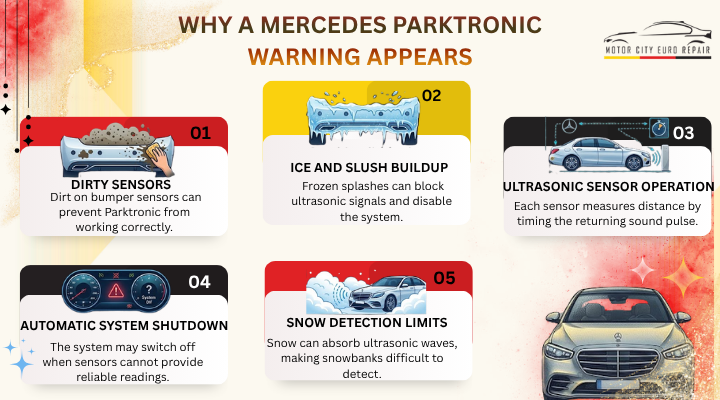
- Clean first: Mercedes says the sensors must be free of dirt, ice and slush to work.
- Snow can hide: Mercedes says the sensors may not detect snow, because it absorbs ultrasonic waves.
- Gone after a wash: it was the bumper.
- Back on a clean car: something behind the bumper has failed, whether that’s a sensor, a plug, a corroded wire or the module that runs the whole set.
- Scan before buying parts: the stored faults narrow the search.
A Mercedes Parktronic Inoperative Warning Usually Starts on the Bumper
In November, it’s usually dirt. In the 2016 GLC operator’s manual, Mercedes-Benz describes six ultrasonic sensors in each bumper and says they must be free from dirt, ice or slush to function correctly. Other models count their sensors differently.
Each sensor times a sound pulse bouncing back. Cover one with a frozen splash from Grand River Avenue and the pulse can’t get out cleanly, so the system switches itself off rather than guess at distances. The same manual adds a winter catch: the sensors may not detect snow, because snow absorbs ultrasonic waves. A snowbank behind the car can stay silent with nothing wrong with the system.
How a Dirty Sensor Behaves Differently From a Failed One
Dirt tends to be temporary and spread across the bumper, while a real failure is stubborn and sits in one spot. That pattern sorts most cases.
The GLC‘s display shows the difference. Dirt or interference lights only the red segments and switches Parktronic off, while a fault does the same, adds a warning tone of about two seconds and turns on the lamp in the Parktronic button.
Mercedes’ own cleaning advice is water, car shampoo and a soft cloth, and if you use a power washer, keep the nozzle at least 11.8 inches from the sensors. Let any ice melt in a warm garage, switch the ignition back on, and see whether the warning returns.
Interference is the other false alarm. Mercedes lists an automatic car wash and a truck’s air brakes among the ultrasonic sources that can upset the system, and its fix is simply to try again in a different spot. A failed part acts differently. Move to an open lot with the bumper clean and dry, and the two-second tone and the lit button lamp come straight back.
Salt and Moisture Go After the Wiring Behind the Bumper
When cleaning doesn’t fix it, suspect the connector as much as the sensor. Each sensor plugs into a harness that runs inside the bumper cover, about as close to road spray as any wiring on the car.
Water gets past a tired connector seal. Salt rides in with it. Once green corrosion forms on the pins, the signal drops in and out, which is why some cars lose Parktronic on a frozen morning and get it back by lunch after a drive down I-696. Small bumps count too. A parking-lot tap that leaves no mark can still knock a sensor out of its holder or pull a plug half loose.
A Scan Separates a Sensor Fault From a Module Fault
Parktronic logs its own faults. Read with proper equipment, the codes point to a sensor position or circuit, which tells the technician whether to test one sensor, trace one wire, or look at the control unit that runs the whole set. Mercedes’ own bulletins key on codes too. Its February 2025 service bulletin on the Park Assist Inoperative message, written for cars with a 360° camera, applies only when two specific fault codes are stored in the park control unit.
But a code isn’t a verdict. One fault on a rear sensor can mean the sensor, its plug or a rubbed-through wire, and each needs a different repair, so the readout gets confirmed with an electrical test before parts are ordered. Skip that test and you can pay for a new sensor that was never the problem. On Mercedes electrical faults, Motor City Euro’s specialists work with dealer-level equipment rather than a generic code reader.
What to Expect When You Bring It to Farmington Road
Motor City Euro Repair runs ten bays on Farmington Road. Approvals are digital, with photos and service requests sent straight to your phone or email, so if a green-crusted plug is the culprit, you’ll see it before you authorize the work.
Each service is covered by TechNet’s 3-year/36,000-mile warranty. Loaner cars, a shuttle and after-hours drop-off are all on offer, which helps when the Mercedes is how you get to work in Novi or Livonia. December lots are tight, and a car that can’t sense the bumper behind it is a poor match for them.
Frequently Asked Questions
Q: Why does my Mercedes say Parktronic inoperative in winter?
A: Usually because slush, ice or salt film is covering one or more bumper sensors. Clean them with water and a soft cloth and restart. If the warning comes back on a clean, dry car, have the sensors and wiring checked.
Q: Can I drive with Parktronic inoperative?
A: Yes. The car drives normally, but you lose the distance warnings, and on cars that have it, Active Parking Assist is also unavailable while Parktronic is off. Use the mirrors, and the camera if fitted, until it’s fixed.
Q: How do I know which Mercedes parking sensor is bad?
A: A scan of the stored Parktronic faults usually points to a sensor position or circuit. A technician then confirms it with an electrical test, because a bad plug or wire can set the same code as a failed sensor.
Get the Warning Read Before the Holiday Rush
Leave stubborn ice alone, since a scraper can scratch a sensor face. The shop is at 22455 Farmington Rd, Farmington, MI 48336, with after-hours drop-off and a lockbox described on motorcityeuro.com. In your note, say whether the warning came with a tone and a lit lamp on the Parktronic button, because that one detail separates a dirty sensor from a logged fault.
