

Porsche owners around Farmington ask this every year once the salt trucks start running. You can, and the car will not be quite the same when you reconnect it. A modern Porsche spends its life learning, and pulling the power takes a portion of that learning with it. A 911 that ran beautifully in November can feel oddly unsettled the first week in March.
Quick Summary: Key Takeaways
- Memory is not one thing: some settings survive a disconnect, some do not, and the important ones are the ones you cannot see.
- Throttle and idle adaptations reset: expect a rough idle or a hesitant first few miles until they relearn.
- Steering angle needs a reference: the stability system cannot work without one.
- Windows and sunroof lose their limits: one-touch and pinch protection stop working until reinitialized.
- A maintainer avoids all of it: keeping the battery charged in place is cheaper than the relearns.
The adaptations that disappear
Engine control modules build a running correction table. Fuel trims adapt to injector wear, air leaks and fuel quality. Throttle position learns where the closed stop actually sits after years of carbon. Idle control learns how much air this particular engine needs to hold steady with the air conditioning compressor loading it.
Cut the power and those tables go back to factory defaults. The car relearns them, but relearning takes drive cycles, and until it finishes the engine can idle unevenly, hunt at stops or feel flat off the line. On a PDK car the transmission has its own adaptations for clutch fill pressure, and those take their own time to settle.
Relearning also needs the right kind of driving. Short, cold trips around a neighborhood rarely put the engine into the operating conditions the adaptation routines want to see, so a car used only for errands in March can take weeks to feel like itself. A couple of longer runs at steady throttle do more than a month of five-minute journeys.
Stored fault history goes too, which sounds harmless and is not. If the car had been logging an intermittent misfire or a lazy oxygen sensor before storage, that evidence is gone, and the next diagnosis starts from nothing.
The steering angle sensor and why it is not optional
Electronic stability control is not a convenience feature. The Federal Register rule that brought it in required installation of ESC in 100 percent of light vehicles by model year 2012, with narrow exceptions for small-volume and multi-stage manufacturers. Every one of those systems depends on knowing exactly where straight ahead is.
Some cars relearn that reference by themselves after a few turns lock to lock. Others hold the fault until a scan tool writes a new zero position. A Porsche sitting with a PSM warning lit because nobody reset the steering angle after a battery swap is a car driving without the safety system it was built around.
The tire pressure system often needs the same treatment, and on cars with adaptive dampers the suspension control can hold a fault until it is reset deliberately. None of these clear themselves just because the warning light eventually stops nagging.
Comfort systems that need reinitializing
Windows lose their upper and lower limits, so one-touch up stops working and anti-pinch protection goes with it. Sunroofs behave the same way. Seat memory, mirror positions and the alarm’s learned state can all need redoing, and on some models the tire pressure system wants a fresh reference drive.
None of this is difficult. All of it is annoying to discover one at a time across a couple of weeks of driving, and most of it is avoidable.
Radio and navigation security codes belong on the list for older cars, along with any stored phone pairings. Newer Porsches handle this without owner input, but a 996 or an early Cayenne can greet you with a locked head unit and no obvious way back in.
If the terminal does have to come off, a memory saver plugged into the diagnostic socket holds enough voltage to keep the modules alive during the swap. They are inexpensive, and they turn an afternoon of relearns into a non-event.
The better plan for a Michigan winter
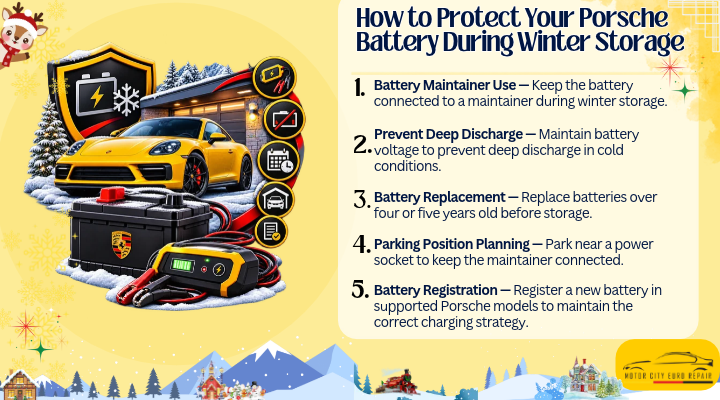
Leave the battery connected and put a proper maintainer on it. A maintainer monitors voltage and feeds a small current only when it is needed, so the modules keep their memory and the battery never sits deeply discharged in a cold garage. Deep discharge in the cold is what actually kills them.
If the battery is already four or five years old, replace it before storage instead of after. A tired battery left through a Farmington winter is a tired battery in April, and the car will have spent three months quietly running it down through its standby loads.
Position the car with that in mind. A maintainer needs a socket within reach, and an extension cord run under a garage door in February is the kind of arrangement that gets unplugged and forgotten. Decide where the car parks before it goes to sleep rather than after.
Worth noting for anyone fitting a fresh battery: many late Porsches want the new battery registered to the car so the charging strategy knows it is dealing with a new one. Skipping that step shortens the life of the battery you just paid for.
Winter Storage Goes Better With a Maintainer
If the Porsche is going away until spring, talk to us first about how to leave it. We are at 22455 Farmington Rd in Farmington, and the rest of what we do is at motorcityeuro.com.
